Since 25 August 1967
The trolleybus
Sumy's first trolleybus ran on 25 August 1967, linking Khimhorodok with the railway station. To get started the city received 25 used MTB-82s from Moscow and 10 new Kyiv-4s.
The fleet peaked in the early 1990s at about 145–157 vehicles. Then for ten years, 1995 to 2005, not a single trolleybus was bought, and by 2010 the fleet had shrunk to 69.
Renewal began in 2015 with twelve Bohdans, Etalons in 2018 and, in 2021, 19 new low-floor vehicles funded by a European Investment Bank loan. In 2024 the operator had 79 trolleybuses on its books, 35 of them Bohdans.
The war has stopped the trolleybus several times. They halted on 3 March 2022 when the power went and returned on 28 March, eight vehicles every 30–60 minutes, free of charge. On 22 June 2026 a guided-bomb strike on the outskirts destroyed a trolleybus and badly wounded its driver.
Minibuses and buses
Minibuses
On 29 October 2011 Sumy redrew its minibus map: 35 new routes replaced 60 old ones, run by private operators. The municipal Elektroavtotrans also runs about 35 buses of its own.
In March 2022 the big municipal buses carried people out along humanitarian corridors, and several Solaris buses were handed over to the army.
- Trolleybus 8 UAH, minibus 15 UAH (May–June 2026; a rise to 20 UAH is under discussion).
- There is no e-ticket yet. Live vehicle positions are in the EasyWay app.
Transport in pictures


Since 1877–78
The railway and station
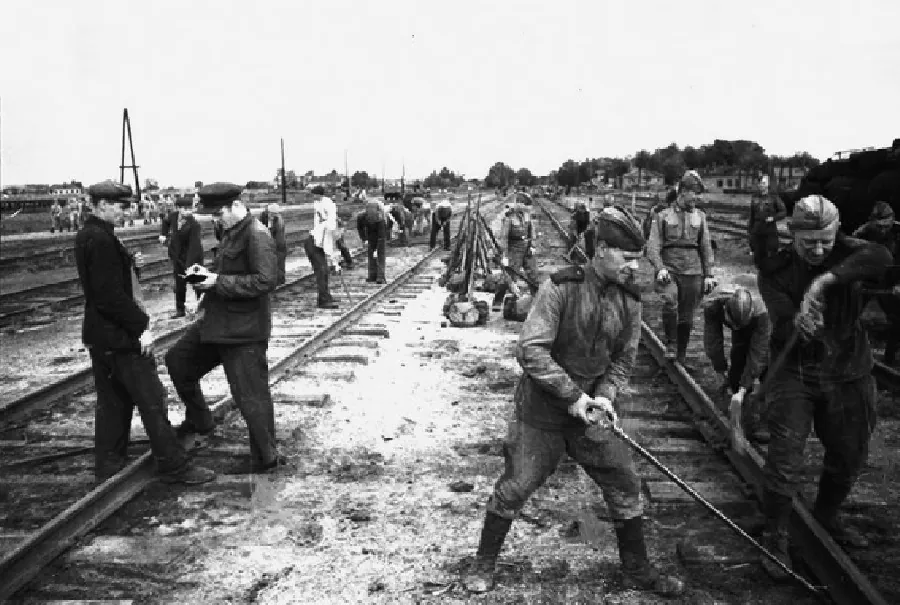
The station opened in 1877 on the Vorozhba–Merefa line of the Kharkiv–Mykolaiv Railway; the first steam train arrived in 1878. The railway took Kharytonenko sugar to imperial markets and gave the city its first paving, starting with the roads to the station.
The station was rebuilt in 1948, a new building went up in 1982, and in 2001–2005 it was renovated together with the platforms and square. On 12 April 2024 a Russian strike blew out its windows.
Autumn 2026. Since 12 September 2026, because of intensified shelling, trains on the Sumy line run only as far as Konotop, and direct Kyiv–Sumy trains were cancelled from 1 October. Ukrzaliznytsia launched a combined ticket: train to Konotop plus a UZ bus to Sumy. The line towards Lyubotyn and Kharkiv still runs.


UMY · UKHS
The airport
Flights from Sumy began in 1978. In 1980 the airport handled about 200,000 passengers on An-24s and Yak-40s to Odesa, Sochi and towns in the region. By 1995 only about 2,000 remained. The runway is 2,500 m long; it got international status in 2006.
In 2020 the state promised to fund a rebuild, but the money never came. In 2022 there was fighting on the airfield, and in 2024 Russia struck it. There are no scheduled flights and Ukrainian airspace is closed.
As of 1 November 2026
How to get to Sumy now
Sumy is a frontline city: alerts and strikes every day, and transport timetables change fast. Everything below comes from Ukrzaliznytsia and local media at the end of October; on the day of travel check the Ukrzaliznytsia app, its contact centre (0 800 50 31 11) and the Sumy regional administration.
- Train to Konotop, bus to Sumy. Since 12 September 2026 trains on the Sumy line run only as far as Konotop, and there are no direct Kyiv–Sumy trains. From 1 October Ukrzaliznytsia launched a pilot, "UZ doveze": when a threat of shelling stops a train short of Sumy, passengers continue by bus. A ticket with the transfer costs the same as a normal one and is sold in the Ukrzaliznytsia app.
- UZ bus Sumy–Konotop. For passengers on the Rakhiv–Sumy and Sumy–Rakhiv trains: from Sumy at 09:00 (Konotop at 11:00), from Konotop at 11:10 (Sumy at 13:10), about two hours on the road. The bus fare is already included in the train ticket. Times may change.
- Bus or minibus. A bus from Sumy to Konotop costs from 375 UAH; a direct minibus from Sumy to Kyiv is about 1,000 UAH (late-September data). Buses from Konotop to Kyiv leave at 05:00.
- Towards Kharkiv. Trains Sumy–Lyubotyn ran in late September (No. 6002 at 08:10 and No. 6004 at 17:35 from Sumy), but the schedule changes, so check booking.uz.gov.ua.
Safety on the road. Bring a charged power bank, documents, water, food, a first-aid kit and warm clothes, and pack a separate grab-bag. Delays of five hours or more are possible, so track your train online. In an evacuation follow the conductor, move away from the carriages without bunching together, and lie face down if there are explosions nearby. Boarding is halted during a red-level alert. Keep an air-alert app on your phone and arrange your accommodation in advance.
Where to stay. Hotels in the centre are working (see the hotels section on the leisure page). Some places were hit: the Optima hotel reopened 57 rooms after a drone strike. Book ahead and phone before you travel to confirm the place is open.
Myth
Did Sumy ever have a tram?
No. You sometimes read about a 'Sumy tram', but there is no reliable evidence: the largest urban transit database lists only trolleybuses in Sumy, and local historians and academic papers say nothing of a tram. A listing in some reference works of a 'horse tram, 1958–1999' is plainly an error. The nearest tram in the region runs in Konotop.
Old days
Cabmen, cobbles and the first cars
In the early 20th century cabmen refused to go to some districts even for extra pay because of the mud. The 1908 bylaws set a speed limit of 11 versts an hour, about 12 km/h, and cyclists had to carry a horn.
The city's first motorist was probably the sugar maker Mykola Sukhanov, mentioned in 1902.
Sources
- Transphoto: Суми, тролейбус
- Trolleybuses in Sumy — Wikipedia
- Цукр: комунальний транспорт, 2024
- КМУ: 19 тролейбусів за кредитом ЄІБ
- Суспільне: як працює громадський транспорт у Сумах
- Суспільне: з 1 жовтня скасовують поїзд Суми — Київ
- LB.ua: поїзди лише до Конотопа, 12.09.2026
- Цукр: як доїхати потягом до Сум, 2026
- Sumy Airport — Wikipedia
- Sumy railway station — Wikipedia
- Д. Кудінов, Сумський історико-архівний журнал, 2022